



Is your hair dry, dull, or brittle, and are you looking for a truly natural hair care solution? Good news: sea buckthorn, that small orange fruit used for centuries in Tibetan and Russian medicine, has a remarkable nutritional profile for hair fibers. Its omega-7 fatty acids, vitamin E, and carotenoids work synergistically on keratin, the protein that makes up 95% of your hair. But you still need to understand how it works—and, above all, distinguish fact from marketing hype.
Does sea buckthorn really contain keratin?
Let’s be clear from the start: sea buckthorn (Hippophae rhamnoides) is a fruit, not a direct source of keratin. Keratin is a fibrous protein produced by the keratinocytes in the hair follicle. No plant produces it. When a repair shampoo claims to contain “sea buckthorn keratin,” it is actually combining two distinct ingredients: hydrolyzed keratin (often of animal origin or derived from hydrolyzed plant proteins such as soy, Glycine soja) and Hippophae rhamnoides fruit extract.
What sea buckthorn really provides is a range of nutrients that support the production and strength of your hair’s natural keratin. This is a crucial distinction. After all, nourishing the hair from within is often better than just patching up the surface.
Omega-7 and fatty acids: the true mechanism of action on the hair shaft
Sea buckthorn oil contains a rare fatty acid: palmitoleic acid, or omega-7. Only four fruits in the world contain it, and sea buckthorn has at least twenty times more of it than the others. Why is this important for your hair? Because palmitoleic acid is the natural substance most similar to human sebum.
When applied to the scalp, this biochemical similarity allows the oil to enhance the protective properties of sebum without weighing it down. As noted by cosmetologist Michel Sabadie (former Vice President of R&D at Shiseido International), the specific fatty acids in sea buckthorn help “compensate for the absence or insufficient presence of sebum” and “slow down dehydration.” For dry and damaged hair, this is a major benefit.
Sea buckthorn oil is also rich in omega-3, 6, and 9 fatty acids, vitamin E (four times more than sunflower oil), and carotenoids (ten times more beta-carotene than a carrot). Together, these nutrients protect the hair shaft from oxidative stress and deeply nourish the hair follicles.
Sea Buckthorn vs. Hydrolyzed Keratin: Which Is Best for Damaged Hair?
Hydrolyzed keratin, found in some shampoo formulas, works on the surface. It temporarily fills in gaps in the cuticle, adds shine, and makes styling easier. It’s an effective “band-aid,” but it washes out with the next shampoo.
Sea buckthorn oil, on the other hand, nourishes the hair shaft from the inside out. Its fatty acids penetrate the hair structure and restore long-lasting suppleness. Dr. A. Vernet, a biologist and researcher, states in the journal Phytothérapie that “folk wisdom and contemporary research confirm the benefits of sea buckthorn oil in protecting and regenerating the skin and mucous membranes” (Vernet, Phytothérapie, 2006). The mucous membranes and the scalp share similar regeneration mechanisms.
The best approach? Combine both methods: use a topical sea buckthorn oil treatment to nourish and protect the hair, and take supplements to support the body’s own production of keratin.
Dry, damaged, brittle hair: how should you use sea buckthorn oil?
Traditional Asian medicine has long recommended sea buckthorn for hair care. Today, the methods of application have been refined. Here is a simple and effective routine:
- As a pre-shampoo treatment: Apply a few sprays of sea buckthorn oil to your scalp and hair. Gently massage it in. Leave it on for 20 to 30 minutes, then wash your hair as usual.
- For daily leave-in care: Apply 2 to 3 sprays to dry mid-lengths and ends to add shine and nourishment without weighing hair down.
- As a dietary supplement: oral intake of omega-7 and vitamin E nourishes the hair follicle “from the inside,” where no topical product can reach.
The Sublimating Secret: a dry oil designed for hair as well
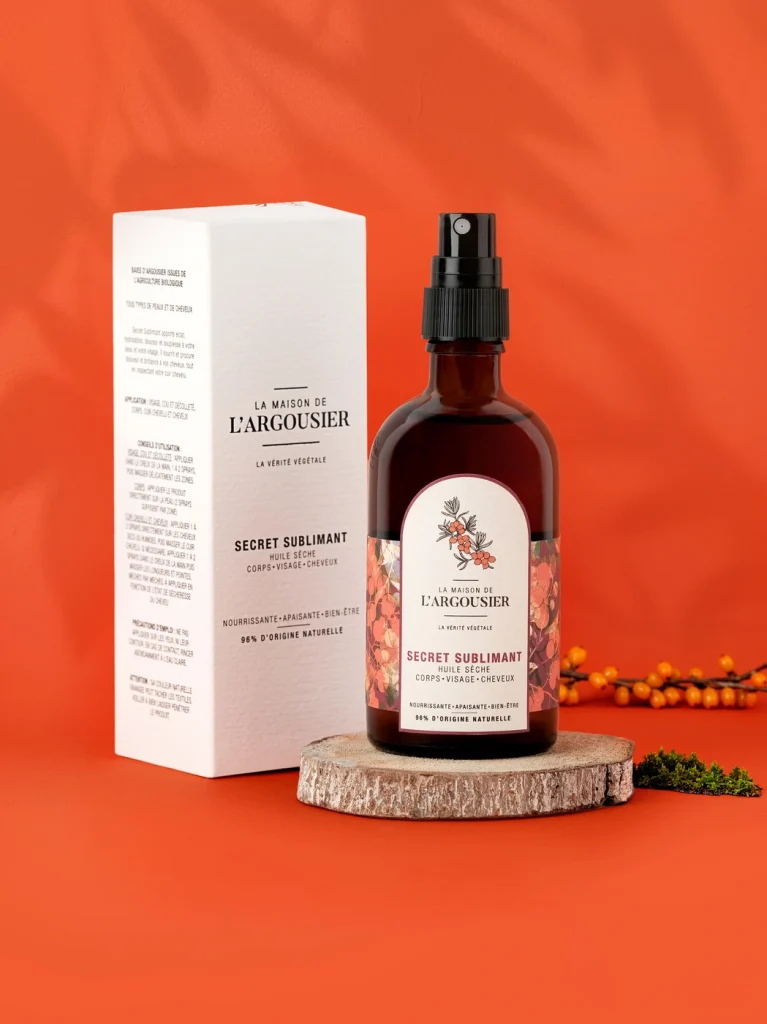
It is precisely to simplify this process that La Maison de l’Argousier has formulated Secret Sublimant. This dry oil for the face, body, and hair contains organic sea buckthorn berry oil (Hippophae rhamnoides fruit oil), plant-based squalane (a natural component of human sebum), grape seed oil rich in omega-6, and soothing sunflower oil.
What makes it special? Thanks to its high palmitoleic acid (omega-7) content, it deeply nourishes without leaving hair greasy. Oily hair isn’t weighed down, while dry hair regains softness and shine. Plant-based squalane enhances this effect by mimicking the natural hydrolipidic film. The product can be used on both dry and damp hair, as a hair mask or as a daily treatment for the ends.
La Rayonnante: Nourishing Keratin from Within
About 75% of skin and hair health depends on internal factors, specifically cell membranes and nutritional balance. Naturopath Myriam Lepetit-Brière confirms this: “What matters most is the internal process. Sea buckthorn provides deep, lasting, and physiological support.”
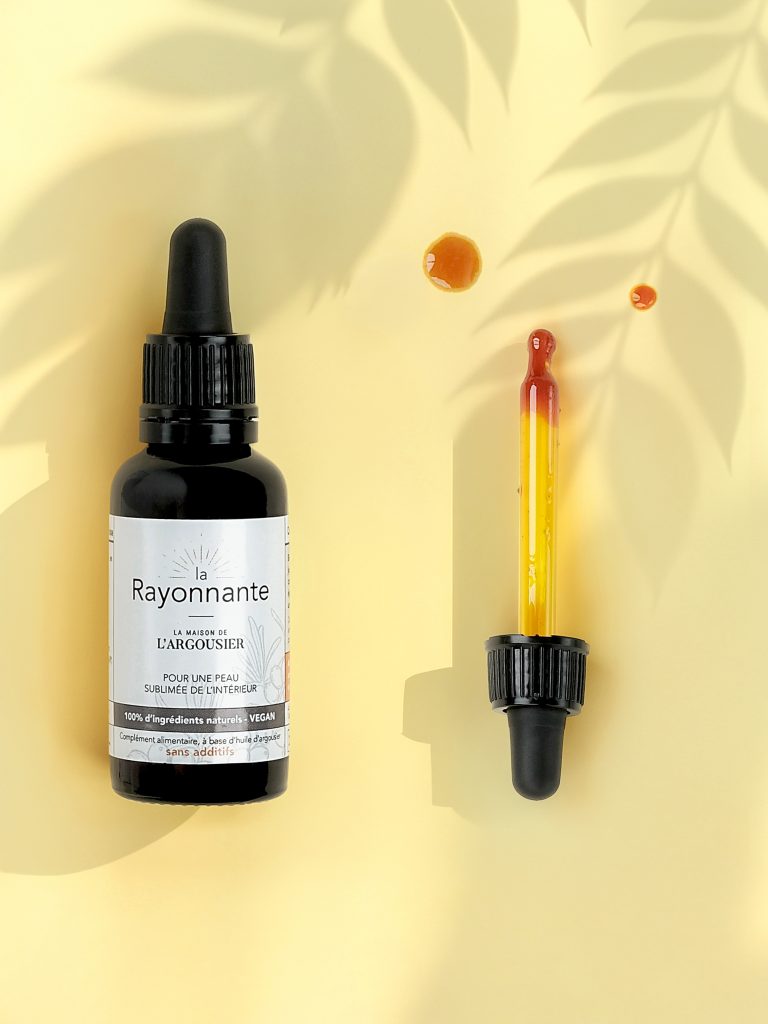
La Rayonnante, a dietary supplement from La Maison de l’Argousier, combines organic sea buckthorn oil, coenzyme Q10, lutein, and vitamin E. Four 100% natural, Clean Label ingredients. The formula specifically targets the mucous membranes, skin, hair, and nails. The omega-7 in sea buckthorn strengthens the scalp’s hydrolipid barrier, while vitamin E (an antioxidant four times more concentrated than in sunflower oil) protects cells from oxidative stress, which is responsible for hair aging.
La Rayonnante is available in a dropper bottle rather than capsules: a deliberate choice made to preserve the bioavailability of the active ingredients and the integrity of the vegetable oil.
What the scientific research says
Research conducted by Thomas Michel at the University of Orléans (ICOA, CNRS) identified 3 phenolic acids and 20 flavonol derivatives in sea buckthorn berries, confirming their significant antioxidant and antimicrobial potential (Michel, Ph.D. thesis, 2011). These flavonoids and proanthocyanidins help protect the scalp from external aggressors and cellular aging.
Sea buckthorn and keratin shampoos: understanding INCI lists
Are you the type who checks the label before buying? Perfect. Here’s what to look for in the INCI list of a sea buckthorn keratin repair shampoo:
- Hippophae rhamnoides fruit oil / fruit extract: sea buckthorn in its active form. The higher it appears on the list, the more concentrated it is.
- Hydrolyzed Vegetable Protein: plant-based keratin (often derived from Glycine soja). A vegan alternative to animal keratin.
- Sodium Coco-Sulfate, Cocamidopropyl Betaine, Lauryl Glucoside: cleansing surfactants. The latter two are gentler.
- Benzyl Alcohol, Phenoxyethanol, Sodium Benzoate, Potassium Sorbate: preservatives. Use with caution if you have a sensitive scalp.
Regardless of the product, check that Hippophae rhamnoides isn’t listed at the end of the INCI list: that would mean the concentration is negligible.
Is sea buckthorn suitable for all hair types?
Whether your hair is curly, frizzy, colored, fine, or thick, sea buckthorn oil works remarkably well on all hair types. Its sebum-regulating properties (it balances sebum production in both directions) explain its versatility. On oily hair, it reduces excess sebum. On dry and damaged hair, it compensates for the lack of protective lipids.
For colored hair, the natural antioxidants in sea buckthorn (vitamin E, carotenoids, polyphenols) help protect the hair shaft from oxidative stress caused by chemical hair dyes. No specific contraindications have been documented, including during pregnancy or breastfeeding, as sea buckthorn is a fruit traditionally consumed. If in doubt, a patch test on the inner elbow remains a reasonable precaution.
Enhance Your Hair: The Sea Buckthorn Routine in Practice
For visible results, consistency is more important than intensity. Here is a comprehensive approach that combines external care with internal nutrition:
- Morning: 1 dropper of La Rayonnante, taken neat or mixed with food. 28-day course of treatment; repeat as needed.
- For daily use: Apply 2 to 3 sprays of Secret Sublimant to the mid-lengths and ends after styling.
- 1 to 2 times a week: Apply a hair mask using Secret Sublimant. Massage into the scalp, leave on for 20 minutes, then wash with your usual shampoo.
The integration of internal and external elements is the philosophy behind La Maison de l’Argousier!
The information provided is for informational purposes only and does not constitute medical advice. Consult your doctor or pharmacist.
Sources and references
- Vernet, A. “Sea Buckthorn (Hippophae rhamnoides L.)”. Phytothérapie, 4, 125–129, 2006. Link
- Michel, T. “New Methods for Extraction, Fractionation, and Identification: Application to Bioactive Compounds from Sea Buckthorn (Hippophae rhamnoides).” Ph.D. dissertation, University of Orléans, ICOA-CNRS, 2011. Link
- NMR Analysis Report, Sea Buckthorn Berries from La Maison de l’Argousier (internal data).
- Clinical trials of Secret Sublimant, Eurofins, 22 volunteers, 21-day protocol (internal data from La Maison de l’Argousier).
- Luetjohann, S. (2002). Sea Buckthorn: An Energy-Packed Fruit and Beneficial Oil.


 Free shipping when you buy 2 or more items!