


Imagine being invited to listen to a symphony orchestra… but hearing only a single violin. Frustrating, isn’t it? The “totum vegetale” concept is exactly that: prioritizing the complete symphony of a plant over a single isolated note. It’s a concept that dates back a thousand years, rediscovered by modern science, and one that is profoundly changing the way we formulate skincare products and dietary supplements.
The plant as a whole: defining a foundational concept in herbal medicine
The word “totum” comes fromthe Latin*totus*, which means “all, the whole, the entirety.” In pharmacognosy, the totum of a plant refers to the entirety of its constituents: active ingredients, metabolites, precursors, vitamins, minerals, and trace elements. In other words, it is the plant in its chemical entirety, without sorting or isolating molecules.
The concept of the totum stands in direct contrast to the traditional phytochemical approach, which involves extracting a single active ingredient from a medicinal plant to create a drug. A plant contains several hundred different chemical constituents. Each is present in varying amounts—often small—but each plays a role in the overall effect.
The founding principle was articulated by Avicenna, a Persian physician and philosopher (980–1037):“The whole is greater than the sum of its parts.”With the totum, mathematical laws are defied. 1+1 is far more than 2.
Why the whole plant is more effective than an isolated molecule
The key to understanding the plant as a whole issynergy. Derived fromtheGreekword *synergos*(to work together), this term refers to the phenomenon whereby several components of a plant interact to produce an effect greater than that of each individual component taken separately.
Specifically, synergy manifests itself in three ways within a plant’s totum:
- Synergism: one component enhances the effect of another. In valerian, the hypnotic effect of hesperidin (a flavonoid) is greatly enhanced by 6-methyl-apigenin, which on its own has no hypnotic properties (Marder et al.,Pharmacology, Biochemistry and Behavior, 2003).
- Synergy: Different groups of active ingredients act on different targets. Hawthorn, for example, simultaneously regulates heart rate, blood pressure, and anxiety thanks to its combination of procyanidins, flavonoids, and amines.
- Quenching: one component counteracts the undesirable effect of another. Citral, which is irritating to the skin when isolated, poses no problem in lemon essential oil, where d-limonene and α-pinene neutralize this effect.
Mathematical modeling has confirmed that synergy significantly increases the magnitude of the cellular response, even at low stimulation doses. The degree of synergy depends on the total dose and the proportion of each component, but remains independent of the relative potency of each active ingredient taken separately.

Whole plant extracts, standardized extracts, and essential oils: what are the differences?
These three approaches are often confused. However, they do not share the same objective or yield the same results.
A standardized extract concentrates a target molecule but loses the overall synergy. St. John’s wort is a good example: isolated hypericin has a weaker antidepressant effect than the whole extract, in which procyanidins and flavonoids modulate its action.
For essential oils, whole-plant extraction (gentle, complete, unfractionated distillation) preserves the molecular integrity. The AFEDI (expert consensus, 2018) emphasizes that the action of a whole essential oil differs from that of its isolated constituents, notably with often reduced toxicity.
White Willow: When the Whole Plant Outperforms Aspirin
The example of the white willow is a striking illustration of the power of the totum. Willow bark contains salicoside, a precursor to salicylic acid (the precursor to aspirin). But it also contains salicortin, tremulacin, populin, flavonoids, and tannins.
Clinical trials have shown that a willow extract equivalent to 240 mg of salicoside per day relieves osteoarthritis pain with an efficacy comparable to 500 mg of aspirin. The explanation? The various salicylates are released in a cascade, at different rates. Tremulacin and populin prolong the metabolism time. Result: more than 86% of the salicylates are absorbed, with a constant plasma level maintained for several hours.
And the key benefit of Totum: its naturally occurring polyphenols help alleviate the stomach irritation caused by synthetic acetylsalicylic acid.Equivalent effectiveness, fewer side effects.That’s the Totum effect at its best.
Preserving the whole plant: the extraction process is crucial
It is not enough to simply claim that a plant’s whole plant is used. The extraction process must also effectively preserve all of its components. Plant-based raw materials are delicate: heat, chemical solvents, and prolonged drying degrade the most sensitive active ingredients.
Among the extraction methods that preserve the whole plant:
- Cryogenic grinding: The plant material is pulverized in liquid nitrogen at -196 °C and then cold-ground. This process prevents thermal degradation and preserves the enzymatic structure.
- Enzymatic extraction: without the use of solvents or heat, this process separates the different fractions of the plant (water, oil) while preserving the integrity of each group of constituents. It is this type of process that makes it possible, for example, to recover both the natural water content of a fruit and its vegetable oil.
- Supercritical CO₂ extraction: particularly effective for lipophilic compounds, it leaves no solvent residue.
Conversely, extraction using organic solvents or excessive heating may damage fragile molecules such as vitamin C or certain polyphenols. A characterization study conducted by the University of Orléans on sea buckthorn berries (Dr. Christophe Hano, University of Orléans) has also shown that the content of polyphenols and carotenoids varies considerably depending on the extraction method used.
Sea buckthorn: a plant that stands out for its nutritional richness
Not all plants lend themselves equally well to the totum approach. Sea buckthorn (Hippophae rhamnoides) is a classic example. Its berries contain more than 200 bioactive molecules divided into two complementary fractions:
- The aqueous fraction(natural fruit juice): vitamin C (9 times more than an orange), malic acid, polyphenols including quercetin, flavonoids, minerals, and trace elements.
- The lipid fraction(berry oil): omega-3, 6, 7, and 9 fatty acids, beta-carotene (10 times more than a carrot), vitamin E (4 times more than sunflower oil), retinol, phytosterols, and tocopherols.
High-field NMR spectroscopy analysis of sea buckthorn berries has identified organic acids (malic acid, quinic acid), sugars, L-quebrachitol, vitamins C, E, and A, saturated and unsaturated fatty acids, carotenoids, and phenolic compounds in various forms. This exceptionally diverse chemical composition makes the sea buckthorn berry a plant whole of rare richness.
In vitro analyses conducted on sea buckthorn skin and seeds demonstrate antioxidant and anti-inflammatory activity, with high levels of polyphenols (up to 81.7 mg/g in the seeds) and carotenoids (93.8 mg/g in the skin). Toxicological tests confirm excellent biocompatibility, with a hemolysis rate of less than 5% for all extracts tested.
From the whole plant to biomimetic cosmetics
The totum approach is particularly well-suited to cosmetics. Rather than incorporating an isolated active ingredient into a formula, the totum approach involves recreating the plant’s natural composition within the skincare product, just as it exists in the fruit.
For sea buckthorn, this means combining the berry’s natural juice with its oil in the exact proportions found in the fruit: 5.6 parts natural juice to 1 part vegetable oil. This biomimicry allows the skin to simultaneously receive water-soluble active ingredients (vitamin C, flavonoids, malic acid) and fat-soluble active ingredients (omega-7, vitamin E, beta-carotene).
There are two key benefits. First, the hydrophilic and lipophilic components complement each other: the natural water provides antioxidant and free-radical-scavenging properties, while the oil nourishes and protects the hydrolipidic film. Second, the synergy between these two components replicates the natural mechanism of the berry, which has developed these molecules to protect its own cells from oxidative stress, cold, and UV rays.
How to spot a genuine Totum on a label
The concept of "totum" is sometimes misused for marketing purposes. Here are some practical guidelines to help you distinguish a product that truly respects the "totum" of a medicinal plant:
- The extraction method is specified: enzymatic extraction, cryogenic grinding, supercritical extraction. The absence of this information is a red flag.
- Several families of ingredients emerge: if the INCI list mentions only a standardized extract consisting of a single molecule, we are no longer dealing with a "totum" approach.
- Chromatographic analyses (HPLC) confirm the active ingredient content, with botanical traceability (Latin name, geographic origin).
Greenwashing is a real thing. A product containing 0.5% of a diluted plant extract is far from being a “totum” skincare product, even if the packaging features a green leaf. The concentration, the type of extraction, and the traceability of the plant-based raw material make all the difference.
Side Effects and Precautions
One of the documented benefits of the whole plant is precisely the reduction in side effects compared to the use of isolated active ingredients. The phenomenon of quenching (attenuation) partly explains this tolerance: certain components of the plant neutralize the undesirable effects of other components.
Dr. Jean Valnet, a pioneer of phytotherapy and aromatherapy in France, already advocated this idea: a natural remedy, used in its entirety, is better tolerated by the body than an isolated chemical compound, whose effects are often more abrupt and prolonged, with increased side effects.
This does not mean there is no risk at all. Medicinal plants contain potent active ingredients. You should:
- Consult a herbalist for long-term treatments
- Check for potential drug interactions
- Avoid combining more than 3–4 plants without expert advice
- If you are pregnant or breastfeeding, always consult a doctor
The information provided is for informational purposes only and does not constitute medical advice. Consult your doctor or pharmacist.
The Sea Buckthorn House and the Totum: A Practical Approach
Recreating the full spectrum of a fruit in a cosmetic product requires complete control over the entire value chain. This is precisely what Maison de l’Argousier does: as the owner of its own certified organic plantations, it harvests its sea buckthorn berries at the optimal time, freezes them within two hours, and then separates the natural juice and oil through enzymatic extraction (solvent-free and without heating). These two components are then reintroduced into the skincare products in the same natural proportions found in the berry.
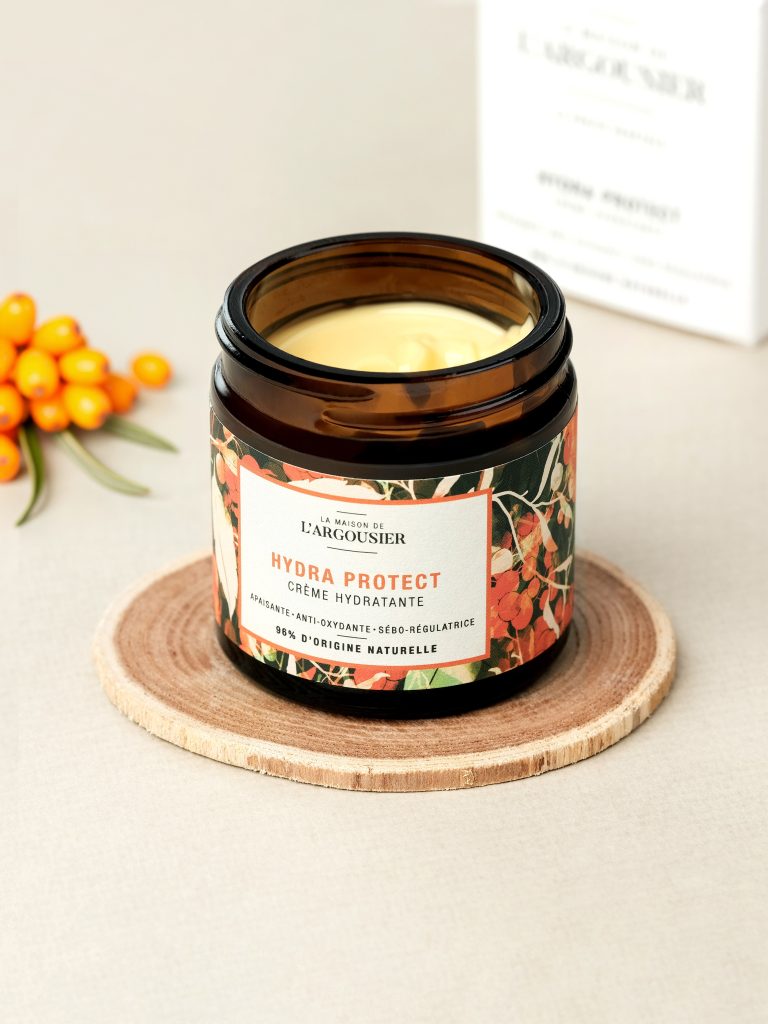
This approach is reflected in products such as Hydra Protect Cream (moisturizing, sebum-regulating, antioxidant) and Secret d’Éclat (pure native water, rich in vitamin C and malic acid). Two different ways to benefit from the full spectrum of sea buckthorn on the skin.
Sources and references
- Marder M, Viola H, Wasowski C, Fernández S, Medina JH, Paladini AC. “6-Methylapigenin and hesperidin: new valerian flavonoids with activity on the CNS.”Pharmacology, Biochemistry, and Behavior, 2003;75(3):537–45.
- AFEDI (2018). “Scientific Aromatherapy: Recommendations for Clinical Practice, Education, and Research.” Expert Consensus, Full Version, April 2018.
- Dr. Christophe Hano, University of Orléans. Report on the phytochemical characterization and cosmetic potential of sea buckthorn (internal data).
- Report on the characterization of sea buckthorn berries using high-field NMR spectroscopy (internal data).


 Free shipping when you buy 2 or more items!