


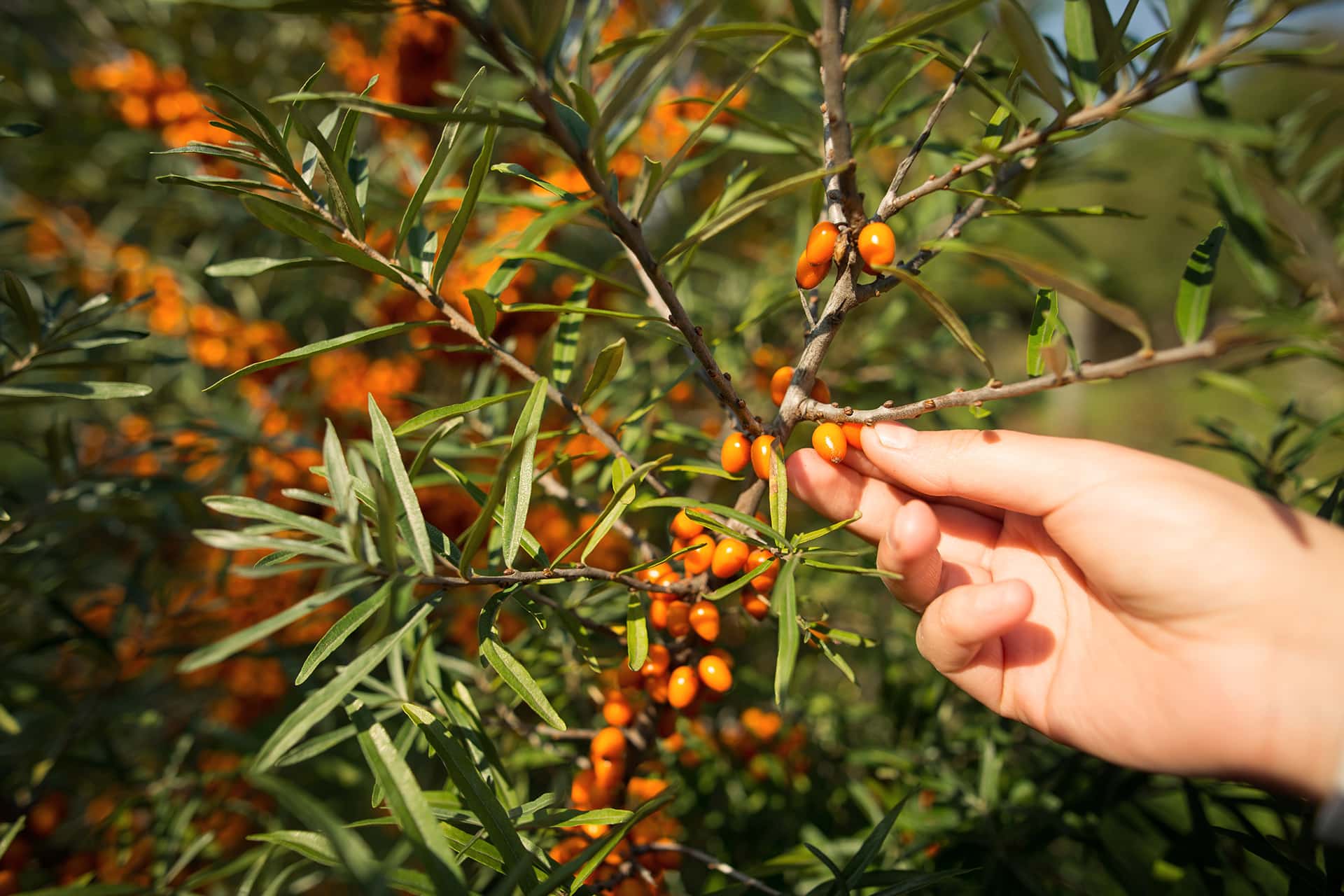
Sea Buckthorn: 6 Benefits You Need to Know
Sea buckthorn (Hippophae rhamnoides) is a shrub whose berries are rich in bioactive compounds. Key facts: 9 times more vitamin C than an orange, a remarkable content of omega-7 (palmitoleic acid)—a rare fatty acid in the plant kingdom—and antioxidant properties comparable to those of blueberries. Sea buckthorn berries nourish the skin, support the immune system, protect the mucous membranes, and contribute to healthy hair and nails. La Maison de l'Argousier extracts the full spectrum of the berry using a solvent-free enzymatic extraction process.
Sea buckthorn, Hippophae rhamnoides: an extraordinary plant extract
Sea buckthorn (Hippophae rhamnoides) is a thorny shrub native to Europe and Asia. Its small orange berries, harvested in the summer, have been used for centuries in traditional Chinese, Tibetan, and Ayurvedic medicine. The first written mention dates back to the 8th century, in a Tibetan treatise.
What makes this fruit so fascinating is its nutritional profile. Per 100 grams of sea buckthorn berries, you’ll find over 400 mg of vitamin C (compared to 50 mg in an orange), 10 times more beta-carotene than in a carrot, and four times more vitamin E than in sunflower oil. All this in a low-calorie fruit (52 kcal/100 g) that is low in sugar and high in fiber.
But the real gem is palmitoleic acid. This omega-7 fatty acid, which is extremely rare in the plant kingdom, is found in significant concentrations in only four fruits worldwide. Sea buckthorn is by far the most concentrated source. According to Vernet’s article published in Phytothérapie (Springer, 2006), the berry has an “exceptional vitamin C content” and properties confirmed by both folk wisdom and contemporary research (link to the study).
The benefits of sea buckthorn for the skin: much more than just a standard skincare product
Let’s talk about what probably interests you the most. Sea buckthorn oil has a lipid profile very similar to that of human sebum. This natural biomimicry explains why the skin absorbs it so easily, without leaving a greasy film or clogging pores.
In practical terms, the many benefits of sea buckthorn for the skin stem from the synergy of its active ingredients:
- Omega-7 (palmitoleic acid): restores the skin barrier and reduces transepidermal water loss. It is ideal for dry skin and tightness.
- Vitamins A and E: As antioxidants, they protect cells from oxidative stress and help maintain skin elasticity. Effective against wrinkles and fine lines.
- Flavonoids (including quercetin): Analyses conducted by Maison de l’Argousier on the enzymatic aqueous extract of the berry have revealed antioxidant, anti-inflammatory, and protective properties against collagen degradation.
- Vitamin C: stimulates collagen production and gives the complexion a visible glow.
For those with atopic skin or skin prone to eczema, sea buckthorn oil has been shown to reduce the symptoms of atopic dermatitis and promote healing, thanks in particular to its anti-inflammatory properties. To date, there are no known cosmetic contraindications.
Sea buckthorn and health: a natural immune booster
With over 400 mg of vitamin C per 100 g of berries—more than four times the recommended daily intake (75 to 90 mg/day)—sea buckthorn is a powerful ally for boosting the immune system. Vitamin C strengthens immune cells and reduces inflammation. It also aids in the absorption of plant-based iron, a valuable asset when dealing with fatigue.
But that’s not all. Sea buckthorn berries contain polyphenols, B vitamins (B1, B2, B5, B6), and minerals (potassium, magnesium, zinc). The reference work by Li and Beveridge (Production and Use of Sea Buckthorn, NRC, 2004) notes that “the peoples of Europe and Asia have known about the medicinal and nutritional benefits of sea buckthorn for hundreds of years” (link to the book).
L’Invincible, a dietary supplement from Maison de l’Argousier, combines 96% organic sea buckthorn oil with natural vitamin D3 and vitamin E. Three ingredients, and not a single one more: a Clean Label formula designed to support the body and its natural defenses every day.
Benefits for the mucous membranes: Omega-7 makes all the difference
Palmitoleic acid, the omega-7 fatty acid found exclusively in sea buckthorn berries, has a special affinity for mucous membranes. When taken orally, sea buckthorn oil helps improve the health of the digestive, ocular, and vaginal mucous membranes.
Regarding dry eyes, oral supplementation with sea buckthorn oil has been shown to reduce redness and a burning sensation. For women going through menopause, the oil may help alleviate vaginal dryness. These properties are attributed to the presence of phospholipids, which facilitate the transport of palmitoleic acid to the affected tissues.
La Rayonnante, another product from Maison de l’Argousier, combines organic sea buckthorn oil, coenzyme Q10, lutein, and vitamin E. These four ingredients are specifically formulated to support the skin, mucous membranes, hair, and nails.
Hair and Nails: Often Overlooked Benefits
Did you know that the Latin name Hippophae comes from the Greek word hippos (horse)? In ancient Greece, farmers fed sea buckthorn berries to their horses to make their coats shiny and glossy. In Mongolia, this tradition continues to this day.
The same principle applies to human hair. The omega-7 fatty acids and vitamin E in sea buckthorn berries nourish the scalp and strengthen the hair shaft. Beta-carotene supports cell regeneration at the hair follicle. In China and Russia, you can also find anti-dandruff and anti-hair loss shampoos formulated with sea buckthorn.
For brittle or fragile nails, taking sea buckthorn as a dietary supplement provides a blend of vitamins and fatty acids that nourishes the nail matrix from within. This is a type of comprehensive care that few natural products can offer.
Anti-inflammatory, antioxidant: what does the data say?
Sea buckthorn has antioxidant properties, as measured by the ORAC (Oxygen Radical Absorbance Capacity) method, comparable to those of raspberries or blueberries. This antioxidant activity is due to the unique combination of vitamin C, tocopherols, carotenoids, and polyphenols found in the berry.
The oil’s anti-inflammatory properties are well documented. Sea buckthorn oil contains sterols (primarily β-sitosterol) and flavonoids that help reduce skin and digestive inflammation. These antioxidant properties of sea buckthorn also explain the positive effects observed on cholesterol metabolism and cardiovascular health.
But please note: while sea buckthorn can complement, support, and contribute to your health, it is not a substitute for medical advice.
How can you tell if a sea buckthorn product is high-quality?
Not all sea buckthorn products are created equal. Here are the criteria to look for:
- Extraction method: Opt for a solvent-free, heat-free extraction method (such as enzymatic extraction) that preserves the integrity of sensitive active ingredients like vitamin C and omega-7.
- Origin and traceability: The variety, growing altitude, and harvest period directly influence the concentration of active ingredients. The Clara variety is among the richest.
- Freshness: Sea buckthorn berries oxidize quickly. Freezing them immediately after harvest (ideally within 2 hours) ensures that the vitamins are preserved.
- Formulation: High-quality sea buckthorn oil should have a natural orange color (indicating a high beta-carotene content) and contain more than 30% palmitoleic acid.
High-quality sea buckthorn oil does not need to be diluted before applying it to the face. Its composition, which is similar to that of sebum, allows for direct application without leaving a greasy feeling, making it suitable for all skin types.
One fruit, many benefits: what you need to know
Sea buckthorn is one of the few fruits that offers benefits for the skin, overall health, mucous membranes, hair, and nails all at once. Its high content of vitamin C, omega-7, antioxidants, and vitamins A and E makes it a versatile ally, with a history dating back centuries and increasingly studied by modern research.
The key lies in the quality of the extraction process and the preservation of the berry’s total composition. La Maison de l’Argousier, which owns 26 hectares of organically certified fields in France, uses an enzymatic process that separates the berry’s natural water and oil without solvents or heat, then reincorporates them into its formulations. A biomimetic approach that respects the fruit’s natural properties.
For your skin, try our orange-scented creams that combine native water and oil. For your health and immunity, La Rayonnante and L’Invincible offer simple, 100% natural formulas in dropper bottles. Your hair, nails, and mucous membranes will thank you.
Sources and references
- Vernet, A., “Sea Buckthorn (Hippophae rhamnoides L.),” Phytothérapie, vol. 4, pp. 125–129, 2006 — Springer link
- Li T.S.C., Beveridge T.H.J., Production and Utilization of Sea Buckthorn (Hippophae rhamnoides L.), NRC, NRC Research Press, 2004 — Google Books link
- Data from NMR spectroscopy analysis of sea buckthorn berries, University of Orléans report (identification of malic acid, quinic acid, vitamin C, vitamin E, retinol, carotenoids, and phenolic compounds).
- Flavonoid analyses and in vitro biological activities; data from La Maison de l’Argousier / ITERG.
Frequently Asked Questions
What are the benefits of sea buckthorn for the liver?
Sea buckthorn contains antioxidants (tocopherols, tocotrienols, carotenoids) whose liver-protective efficacy is comparable to that of milk thistle, according to data compiled in the scientific literature. The sterols and vitamin E in sea buckthorn berries support liver function and aid in the body’s detoxification. These benefits apply to the regular consumption of sea buckthorn oil or juice in reasonable doses.
Is it safe to consume sea buckthorn on a daily basis?
Yes, sea buckthorn oil is very well tolerated when taken daily at the recommended doses. No significant side effects have been reported at normal doses. However, excessive intake may cause mild digestive upset. People taking blood thinners or smokers should consult a doctor due to the oil’s omega-3 and beta-carotene content.
What are the possible side effects of sea buckthorn?
At normal doses, sea buckthorn has no known side effects, whether used topically or as a dietary supplement. Oral overdose may cause mild digestive upset. As a precaution, sea buckthorn essential oil is not recommended for pregnant or breastfeeding women or for children. The vegetable oil, however, has no known cosmetic contraindications.
Is sea buckthorn really higher in vitamin C than oranges?
By a wide margin. Sea buckthorn berries contain more than 400 mg of vitamin C per 100 g, compared to 50 mg in oranges. This is about nine times more, depending on the variety and growing conditions (altitude increases the vitamin C concentration). This exceptional content makes sea buckthorn one of the fruits with the highest concentration of vitamin C in the world.


 Free shipping when you buy 2 or more items!