



Pourquoi la sécheresse intime s’installe : comprendre les causes pour mieux agir
La muqueuse vaginale produit naturellement un fluide lubrifiant, principalement sous l’influence des œstrogènes. Quand le taux de ces hormones chute, la lubrification diminue, les tissus s’affinent et perdent en élasticité. C’est le mécanisme central de la sécheresse vaginale.
La ménopause est la cause la plus fréquente de ce déséquilibre hormonal, mais elle est loin d’être la seule. Le stress, l’anxiété, certains traitements médicamenteux (antidépresseurs, antihistaminiques), la pilule contraceptive, l’allaitement ou encore des pratiques d’hygiène intime trop agressives peuvent aussi provoquer cette sécheresse. Même un savon classique, avec un pH trop alcalin, peut décaper le film hydrolipidique de la vulve et du vagin. Identifier les causes précises permet d’orienter vers un traitement adapté. Votre médecin pourra d’ailleurs vérifier si des déséquilibres hormonaux spécifiques sont en jeu.
La ménopause reste le facteur déclencheur le plus répandu de cette sécheresse, et ses répercussions dépassent largement la sphère intime : peau, yeux, bouche et muqueuses digestives peuvent aussi être touchés. Pour comprendre l’ensemble des liens entre ménopause et ses effets sur les muqueuses, et découvrir comment l’argousier peut accompagner cette transition, nous avons réuni toutes nos ressources sur le sujet.
La sécheresse vaginale ne touche pas uniquement la muqueuse interne. La vulve, les lèvres et la peau périnéale subissent souvent le même assèchement, avec des conséquences sur le confort quotidien bien au-delà des rapports sexuels. Pour explorer toutes les facettes de la sécheresse intime et des muqueuses, leurs causes et les approches naturelles qui existent, nous avons rassemblé l’ensemble de nos ressources sur le sujet.
Les symptômes les plus courants : irritation, sensation de brûlure, démangeaisons, douleurs lors des rapports sexuels (ce que les médecins appellent la dyspareunie), et parfois des irritations vaginales récurrentes. De nombreuses femmes finissent par éviter toute activité sexuelle. Le Dr Lauren Streicher, professeur clinique d’obstétrique et de gynécologie à Feinberg, le rappelle sans détour : « Les femmes post-ménopausées ne devraient pas accepter les rapports sexuels douloureux comme leur nouvelle norme. »
La douleur lors des rapports sexuels est souvent le premier signal d’alerte. Beaucoup de femmes découvrent leur sécheresse vaginale à ce moment précis, alors que le problème s’installait silencieusement depuis des mois. Si vous êtes concernée, notre article sur la sécheresse intime pendant les rapports détaille les solutions concrètes pour retrouver du confort au quotidien.
L’oméga-7 de l’argousier : le remède naturel de référence pour les muqueuses
L’acide palmitoléique, plus connu sous le nom d’oméga-7, est un constituant essentiel des membranes cellulaires des muqueuses. Ce n’est pas un détail : c’est précisément ce dont la muqueuse vaginale a besoin pour maintenir son hydratation et sa souplesse. Et l’argousier en est de très loin la source végétale la plus concentrée, avec une teneur au moins 20 fois supérieure aux autres fruits qui en contiennent (seuls 4 végétaux au monde en renferment). L’argousier possède d’ailleurs des propriétés remarquables qui vont bien au-delà des seuls oméga-7.
Pris par voie orale, l’oméga-7 nourrit et régénère les parois vaginales de l’intérieur. Cette approche naturelle est particulièrement intéressante pour les femmes ménopausées, car elle agit en profondeur sur la santé des tissus. Les oméga-7 protègent la peau des agressions extérieures, limitent l’évaporation de l’eau et maintiennent la douceur et la souplesse de la muqueuse vaginale. Ils agissent également sur d’autres symptômes de la ménopause comme les bouffées de chaleur et le confort cutané global.
Comptez 4 à 8 semaines de cure régulière à raison d’une pipette par jours pour que les acides gras s’intègrent aux cellules des muqueuses et que l’hydratation naturelle soit visiblement restaurée.
L’acide palmitoléique ne se limite pas au confort intime. Cet acide gras rare intervient aussi dans la santé cardiovasculaire, la régulation métabolique et la protection des muqueuses digestives. Pour mieux comprendre l’ensemble des bienfaits de l’oméga 7, un tour d’horizon complet de cet acide gras encore trop méconnu s’impose.
Huile liquide, capsules, jus de baies : toutes les formes d’argousier ne se valent pas en termes de concentration en oméga-7. Avant de démarrer une cure, prenez le temps de choisir la meilleure forme d’argousier pour maximiser les bienfaits sur vos muqueuses. Le mode d’extraction et la partie du fruit utilisée influencent directement la biodisponibilité des acides gras.
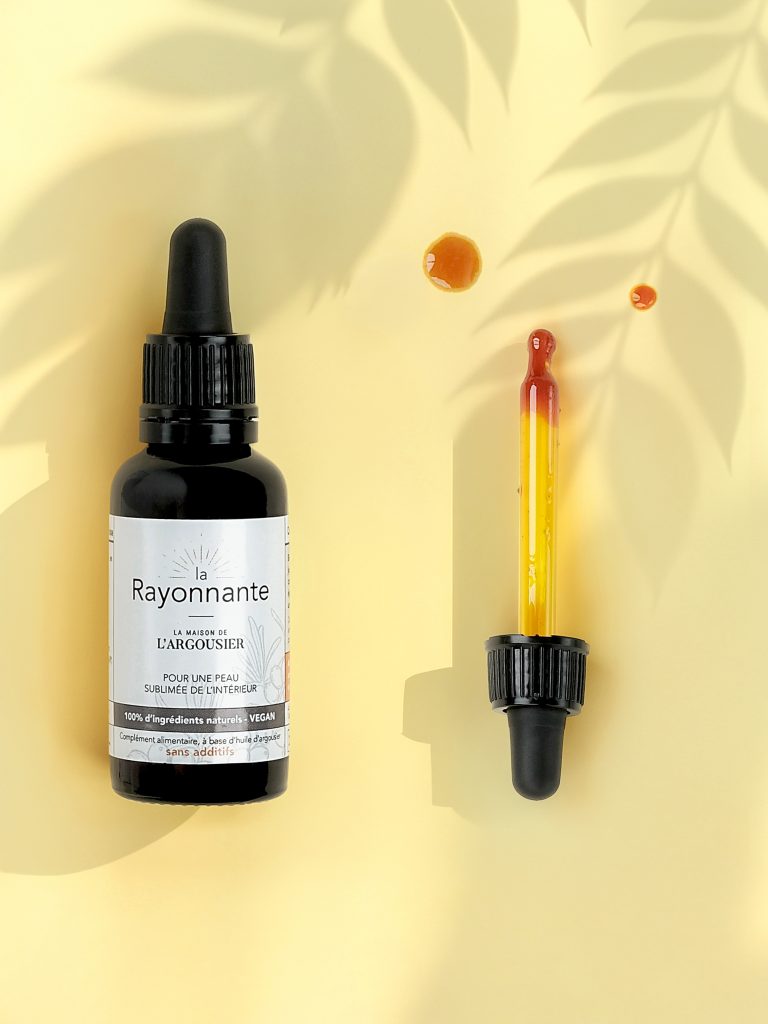
La Rayonnante de la Maison de l’Argousier est un nutricosmétique formulé avec de l’huile de baies d’argousier issues de notre plantation certifiée Agriculture Biologique. Elle est enrichie en coenzyme Q10, lutéine et vitamine E. La formulation est 100 % naturelle, sans additifs, sans solvants et vegan. Pour les femmes qui vérifient chaque étiquette (et elles ont raison), la liste d’ingrédients est remarquablement courte : 4 ingrédients seulement.
Huiles végétales et bains de siège : les remèdes de grand-mère
Les huiles végétales en application locale
L’huile d’amande douce, l’huile de coco, l’huile de bourrache ou l’huile d’argousier contiennent des oméga essentiels à la souplesse des tissus. Mais est la seule qui présentent les oméga-7 recommandés pour la sécheresse intime. Appliquées localement, ces produits naturels peuvent soulager la muqueuse vaginale et atténuer les douleurs liées à la sécheresse.
Attention cependant : ces huiles ne sont pas compatibles avec les préservatifs (elles les endommagent). Et sur de longues périodes, mieux vaut opter pour des solutions spécifiquement formulées pour la zone intime, comme le recommande Céline Hovette, naturopathe spécialiste des problématiques hormonales féminines. Les lubrifiants à base d’eau, sans parfums ni conservateurs agressifs, restent une alternative ponctuelle intéressante.
En complément des huiles végétales, les lubrifiants naturels à base d’eau offrent une alternative compatible avec les préservatifs en latex. Formulés sans parfums ni conservateurs agressifs, ils apportent un confort immédiat lors des rapports tout en respectant l’équilibre de la flore vaginale. Pensez à vérifier la liste INCI, même sur les produits étiquetés « naturel ».
Le bain de siège aux plantes : un remède ancestral
Les bains de siège à base de calendula, camomille, mauve ou sauge sont des remèdes de grand-mère contre la sécheresse intime qui traversent les siècles pour une bonne raison : ils fonctionnent. Ces plantes médicinales recèlent des propriétés apaisantes et anti-inflammatoires bien documentées. Préparez une infusion concentrée, versez-la dans une bassine d’eau tiède (jamais chaude) et restez assise 10 à 15 minutes. La guimauve et la mauve, riches en mucilages, créent un film protecteur particulièrement apaisant. Ce liquide sirupeux peut aussi servir de soin lavant ultra-doux, bien plus respectueux que n’importe quel savon.
Alimentation et flore vaginale : soulager la sécheresse intime de l’intérieur
Une alimentation équilibrée et riche en bons gras pour des muqueuses hydratées
On sous-estime souvent l’impact de l’assiette sur le confort intime. Pourtant, un régime alimentaire équilibré, riche en acides gras oméga-3 et oméga-6, favorise la production naturelle de fluides et la souplesse des tissus. Concrètement, cela signifie : sardines, maquereaux et harengs 2 à 3 fois par semaine ! Les phyto-œstrogènes naturels du soja et des légumineuses peuvent aussi mimer l’action des œstrogènes manquants. Et n’oubliez pas le plus simple : boire suffisamment d’eau tout au long de la journée.
Probiotiques et yaourt nature : rééquilibrer la flore vaginale
La flore vaginale est un écosystème fragile. Quand cet équilibre se rompt, la sécheresse s’aggrave et les infections prolifèrent. Les probiotiques, sous forme de yaourt nature aident également à restaurer cet équilibre. Appliquer du yaourt nature en petite quantité sur la zone vulvaire est un vieux remède de grand-mère qui fonctionne grâce aux bactéries lactiques qu’il contient. Céline Hovette recommande en particulier la souche Lactobacillus crispatus, efficace pour soutenir l’hydratation et renforcer l’immunité locale. Associés à une cure d’oméga-7 de l’argousier, les probiotiques forment un duo particulièrement cohérent.
Sécheresse vaginale à la ménopause : faut-il obligatoirement des hormones ?
Non. Les traitements hormonaux substitutifs ne sont pas la seule option. Beaucoup de femmes ménopausées retrouvent un confort intime satisfaisant grâce à une approche naturelle combinant plusieurs traitements doux : oméga-7 par voie orale et en application locale, alimentation équilibrée, probiotiques. La naturopathe Myriam Lepetit-Brière confirme : elle recommande souvent l’argousier en complément alimentaire chez les femmes en périménopause, « une période où les muqueuses deviennent plus sèches et plus sensibles ».
Cela dit, certaines situations nécessitent impérativement un avis médical. Si la sécheresse vaginale persiste malgré un mois de remèdes naturels, si elle s’accompagne de saignements après les rapports sexuels, de pertes odorantes ou de douleurs pelviennes, consultez votre médecin. Un diagnostic précis est indispensable pour un traitement adapté, car derrière une sécheresse intime peut se cacher dysfonctionnement plus profond.
Hygiène intime et gestes du quotidien : ce qui aggrave et ce qui fonctionne
Quelques réflexes simples peuvent considérablement soulager les symptômes de la sécheresse intime :
- Privilégier les vêtements en coton : les sous-vêtements synthétiques favorisent l’irritation et la macération.
- Bannir les savons classiques : même les gels douche « doux » ont souvent un pH trop alcalin. Utilisez de l’eau claire ou un soin lavant ultra-gras au pH adapté.
- Éviter les douches vaginales : elles déséquilibrent la flore vaginale et aggravent les douleurs.
- Pratiquer les exercices de Kegel : quelques minutes par jour suffisent pour favoriser la vascularisation de la zone vaginale et soutenir la lubrification naturelle.
- Lire les étiquettes des lubrifiants : évitez les produits vaginaux contenant parabènes, silicones, propylène glycol ou parfums de synthèse. Optez pour des lubrifiants naturels à comme ceux à base d’argousier. La Rayonnante de la Maison de l’Argousier, par exemple peut tout à fait être utilisée dans ce sens.
- Intégrer à sa routine un complément alimentaire à base d’oméga-7.
Les informations présentées sont données à titre informatif et ne constituent pas un avis médical. Consultez votre médecin ou pharmacien.
Sources et références
- Communiqué de presse La Maison de l’Argousier, « Une solution naturelle pour le confort intime : l’huile de baies d’argousier » (données internes).
- Témoignage de Myriam Lepetit-Brière, naturopathe, communiqué de presse La Maison de l’Argousier (données RAG internes).
- Céline Hovette, naturopathe spécialiste des problématiques hormonales féminines, citée dans Alternative Santé.
- « Diagnosis, causes, and treatment of dyspareunia in postmenopausal women », Menopause, juin 2023.


 Livraison offerte dès 2 produits achetés !